People
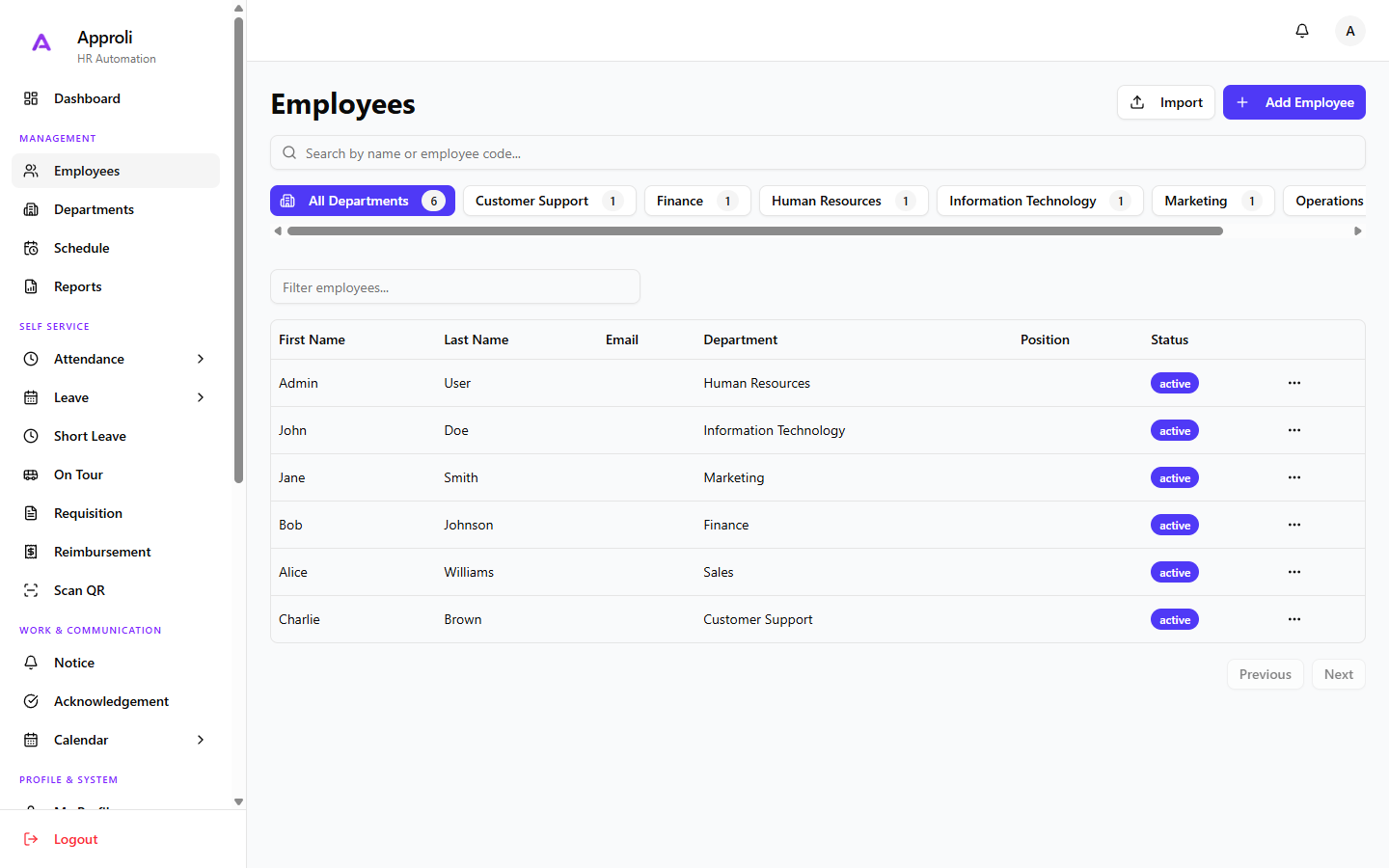
Employee records, departments, documents and the reporting lines every approval follows.
HR + workforce automation
Approli connects employee management, attendance, leave, payroll operations, scheduling, permissions and reporting — then automates the workflows between them. From routine approvals and attendance rules to alerts, replacements and payroll processes, Approli helps your organization spend less time managing HR tasks and more time running the work.
Native automation
Automation in Approli is not a plug-in or a separate workflow tool. It is built into the same records your HR team already keeps, and it runs on a schedule — whether or not anybody remembers.
Every 15 minutes
Opens scheduled days nobody clocked into — where you have allowed it — closes the ones left open, and checks every department against its staffing minimum.
Every morning
Sends the calendar reminders people subscribed to, so the day’s leave, holidays and entries arrive before anyone asks.
Every night
Starts and ends leave-cover delegations on their dates, reviews the day’s attendance and runs the compliance checks.
Every month
Drafts payslips on the 25th from the hours that were actually recorded, not the hours somebody typed in afterwards.
The foundation
Approli starts with the everyday work of people management, then connects those records to the rules, thresholds and schedules that act on them.
Employee records, departments, documents and the reporting lines every approval follows.
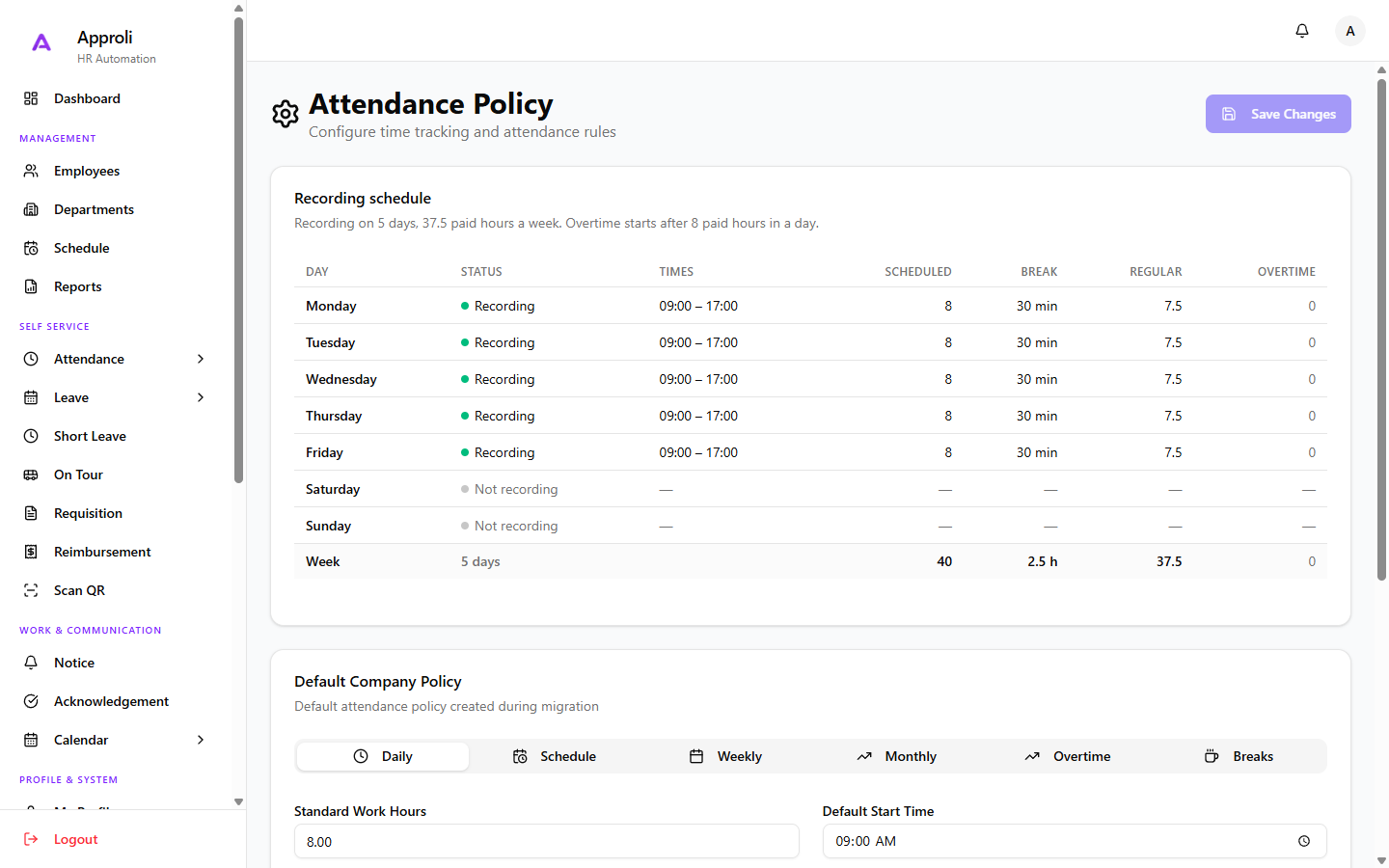
Attendance, per-day schedules, breaks, grace periods and overtime, counted the same way every time.
Leave, short leave, tours, requisitions and reimbursements, each with an approval path that does not stall.
Payslips, tax, billable hours, insurance and reports, built from the same records as everything else.
Continuity
In most HR systems, one person's leave stops everybody else's requests. In Approli, their approvals move to a delegate for exactly the dates they are away — and the temporary access ends on its own when they return, so it never quietly becomes permanent.
Permission control
Responsibility stays visible.
What runs by itself
HR should not have to discover every problem by hand. Each of these is a rule an administrator sets once; from then on the platform checks it, acts on it and records what it did.
Automatic attendance is granted to a person for a stated reason — an approved tour or requisition — for a set period. It ends on its own, and can be revoked the moment plans change.
A day left open is closed at its scheduled end. Automatic clock-in, where it is on, never runs ahead of the clock, expires if the scheduler was late, and never overwrites a real clock-in, leave or a filed absence.
Set working hours, breaks and grace per day of the week. Past the daily hours, overtime starts counting — and payroll reads the same numbers.
When a manager is on leave, their approvals move to a delegate for exactly those dates. On the day they return, the access ends without anybody remembering to remove it.
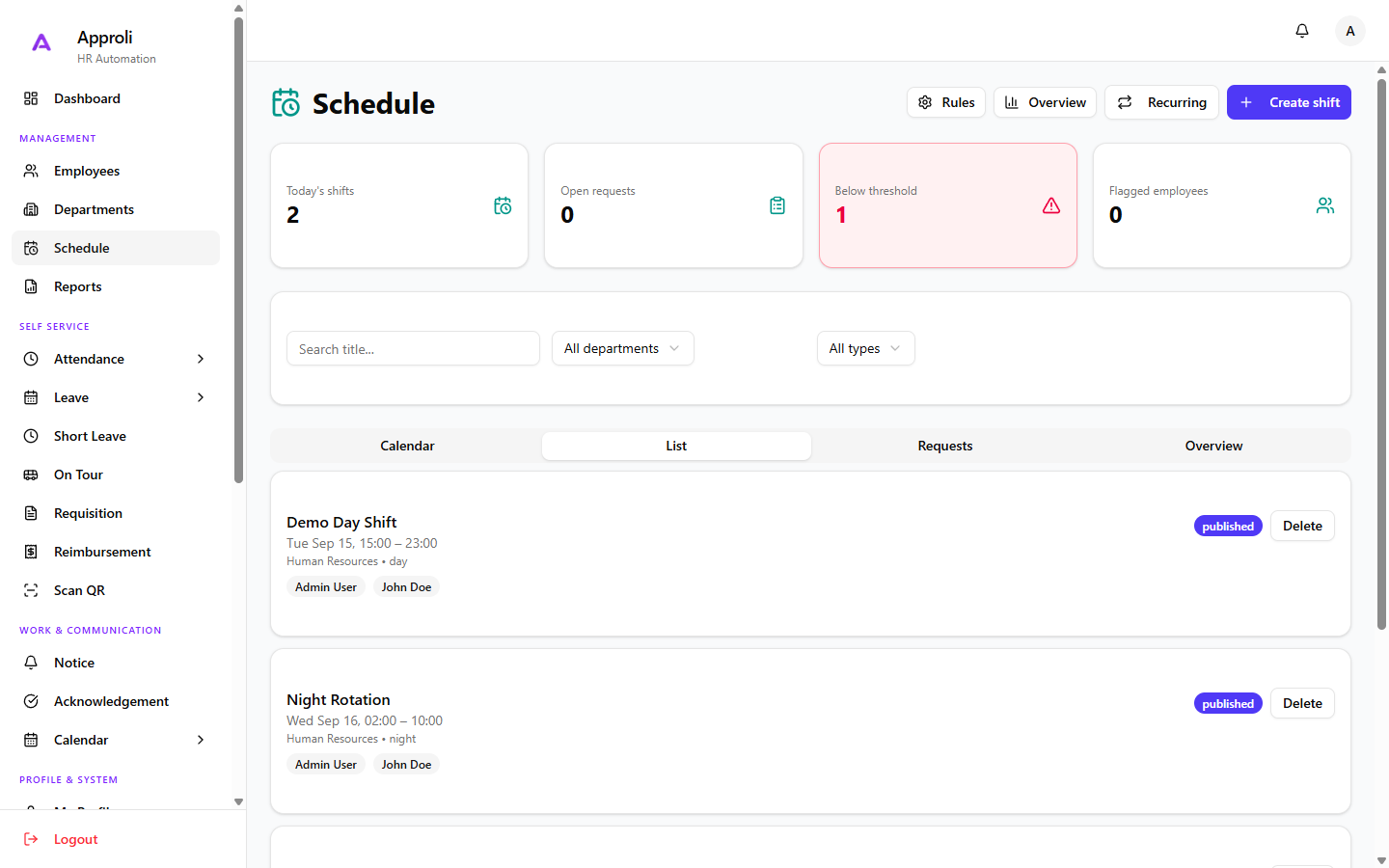
Staffing minimums are checked on a schedule. When a department falls short, Approli asks for cover — from a backup pool, or from other departments in the order you have set.
Approving leave updates the balance, tells the employee in the app and by email, and places it on their Google Calendar if they have connected one. Nobody re-keys it anywhere.
Inside the product
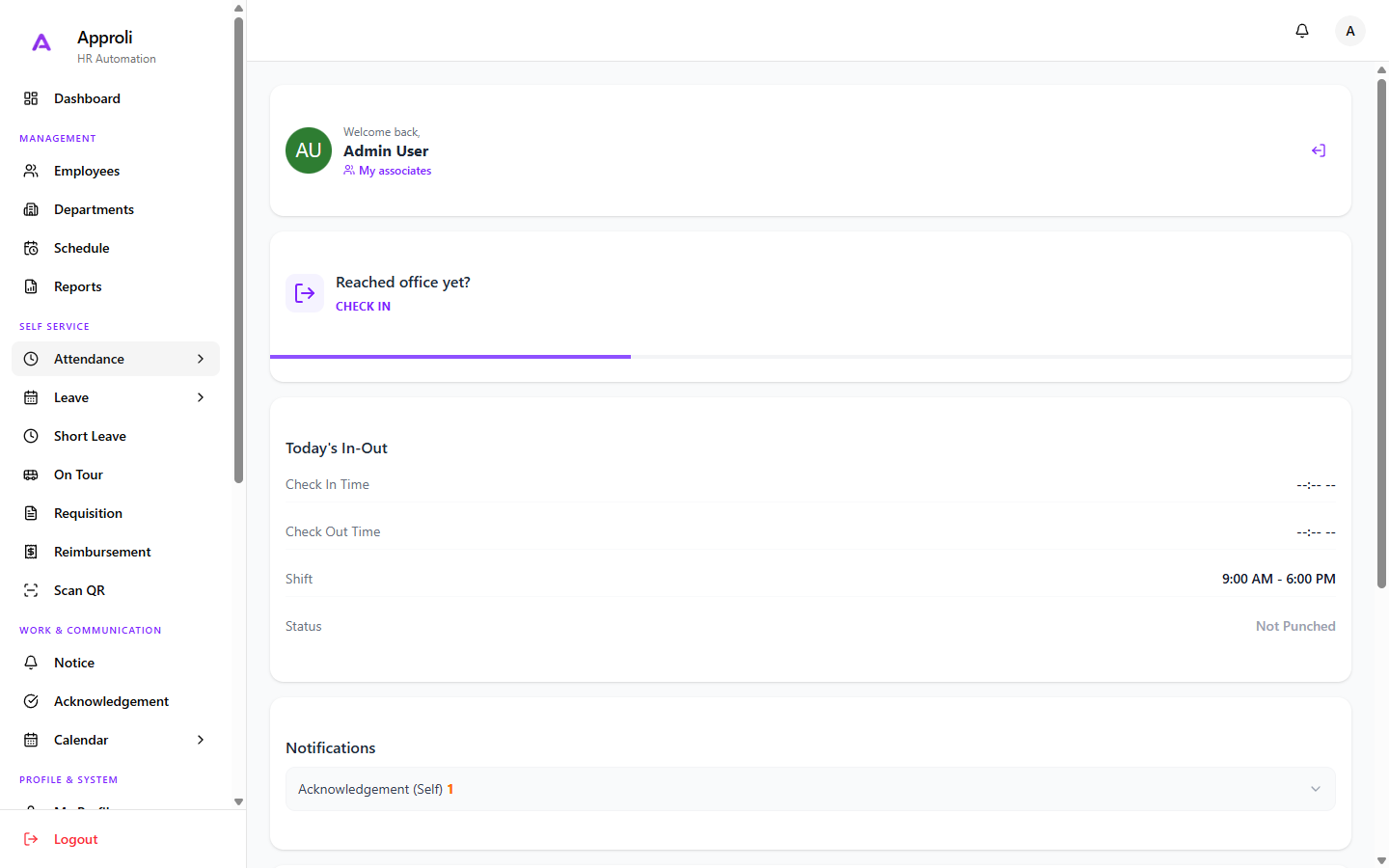
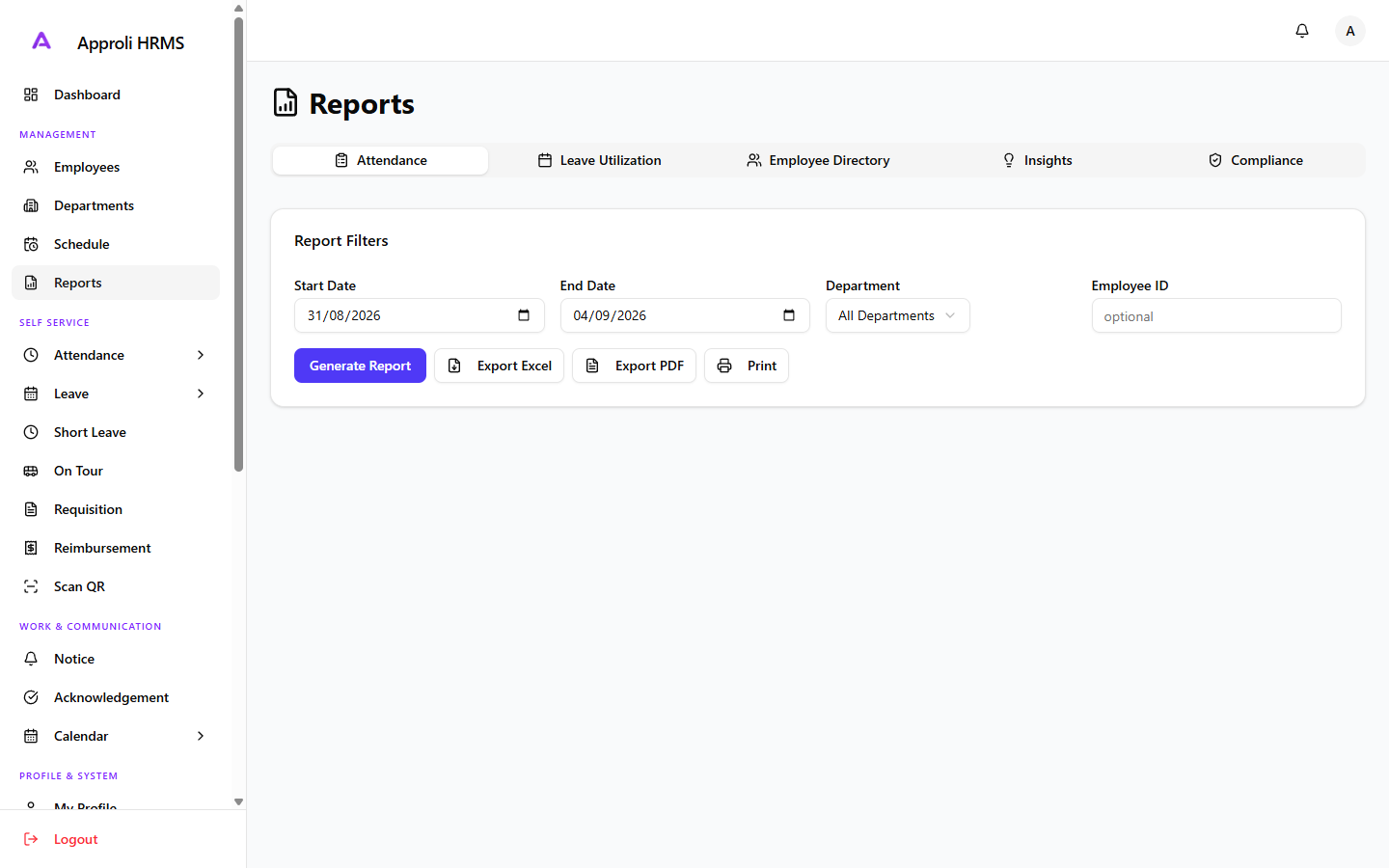
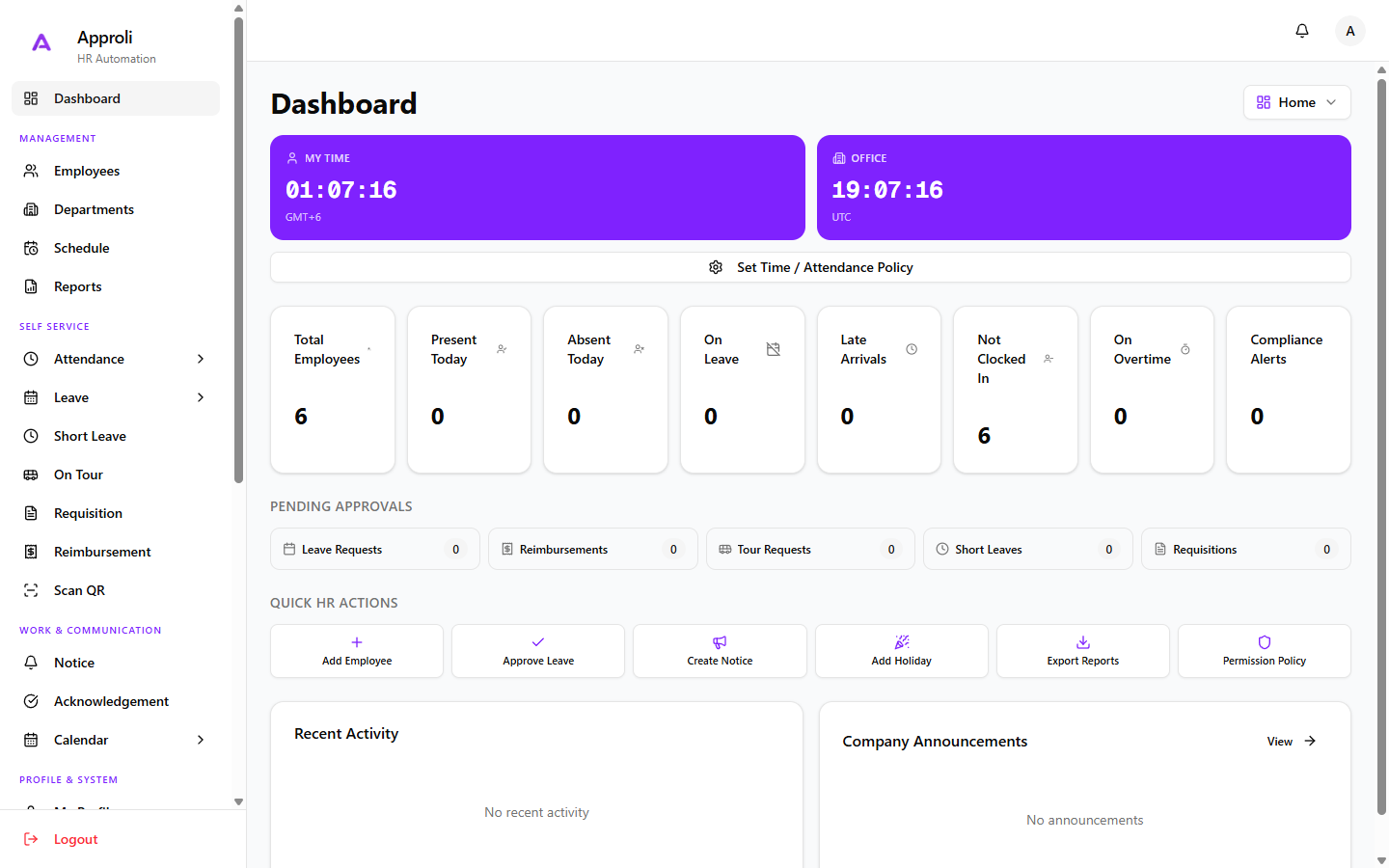
Every screen here is a capture of Approli running. Names and figures are demonstration data; the interface is the one your team would use.
Who is in, who is away, what is waiting for approval and what needs doing — before you have opened anything else.
Approli vs. a typical HR system
The difference is not the list of modules. It is what happens at the moments when an HR system usually hands the work back to a person.
| The moment | A typical HR system | Approli |
|---|---|---|
| A manager goes on holiday | Approvals wait until they are back, or somebody is given their access and keeps it. | Approvals move to a delegate for those dates, and the delegation ends on its own. |
| Somebody forgets to clock out | Found at payroll time and corrected by hand, if it is found at all. | The day is closed at its scheduled end, and the record says a machine did it. |
| A department runs short | Noticed when the shift is already short. | Checked every fifteen minutes, with cover requested from the people you have lined up. |
| Leave is approved | Balance, calendar and email updated separately, by different people. | Balance, notification, email and calendar updated by the approval itself. |
| Payday | Hours gathered from spreadsheets and re-typed. | Payslips drafted on the 25th from the recorded hours and your overtime policy. |
| A budget needs sign-off | A separate finance tool, and an email thread. | Budgetly, inside Approli: pools, votes, approvals and an audit log. |
Compared with the general HR-software category; individual products and plans vary.
Security + infrastructure
Approli runs on Azure-hosted services with identity-based access between them, secrets held centrally, and a hardening programme with its own automated tests. The security page sets out what is in place today and what is not.
Every record belongs to one organization, enforced in the data layer rather than per screen.
Identity-driven access between services, reducing the number of long-lived credentials in play.
Identity and bank details are encrypted before they are written, and masked when displayed.
Every vulnerability found and fixed carries a regression test that runs before any deployment.
Approli
Start with the HR records you already keep. Write down the rules your organization runs on, and let Approli apply them — every fifteen minutes, every night and every payday.